

AI Overview Summary
Four common vision problems can affect a child’s reading and focus: convergence insufficiency, focusing problems, eye tracking problems, and uncorrected farsightedness or astigmatism. Their signs, like skipping lines or headaches after homework, can look like reading or attention problems. A comprehensive pediatric eye exam at Premier Vision of Dallas in Addison, TX can identify them in children ages five and older.
How a child struggles with reading is a clue to why. A child who skips lines has a different problem from one whose words blur after ten minutes, and both differ from a child who gets headaches every night during homework. These patterns aren’t personality or effort. They usually point to a specific visual skill that isn’t keeping up, and most of them can be found in a single exam.
Convergence Insufficiency: When the Eyes Struggle to Team Up for Reading
To read, both eyes have to turn slightly inward and hold that position on the page. In convergence insufficiency, the eyes have trouble doing that comfortably, so they drift or work overtime to stay together. It’s common, affecting around 5% of school age children, and it rarely shows up on a school screening because distance vision is usually fine.
Common convergence insufficiency symptoms include:
- Words that seem to move, float, or double on the page
- Headaches or eye strain after reading or homework
- Losing focus or giving up after a few minutes of reading
- Covering or closing one eye to read
- Reading comprehension that drops the longer they read
TL;DR (Convergence insufficiency): Convergence insufficiency makes it hard for both eyes to work together up close. It often causes headaches, moving words, and short reading stamina, and school screenings usually miss it.
Focusing Problems That Make Words Blur Over Time
The eye’s lens adjusts constantly to keep close work clear. When that focusing system tires too fast, a condition called accommodative insufficiency, a child starts reading clearly and then the words go soft. They aren’t losing interest. Their focus is running out.
You might notice your child holding books very close or very far away, rubbing their eyes during homework, or doing well on short assignments and falling apart on long ones. Focusing problems often appear alongside convergence insufficiency, since the two systems work together.
Eye Tracking Problems: Skipping Lines and Losing Their Place
Reading a line of text takes a series of small, precise eye jumps from word to word and then back to the start of the next line. When those movements aren’t accurate, a child skips words, skips whole lines, or rereads the same line twice without noticing.
The giveaway is often a finger or a bookmark. Children with tracking problems use them to hold their place long after classmates stop. Reading is slow and choppy, and copying from the board is harder still, because the eyes have to find their place again every time they look up.
Farsightedness and Astigmatism Kids Can Pass a Screening With
Farsightedness in children is easy to miss because young eyes can often force distance vision clear by focusing harder. A farsighted child may read the chart across the room just fine, then struggle with the page in front of them. That extra effort shows up as fatigue, headaches, or simply avoiding books.
Astigmatism blurs vision at every distance, but children rarely report it because they’ve never seen any other way. Both are corrected with an accurate prescription, which is why a full refraction matters more than a chart read.
When one eye has a much stronger prescription than the other, the brain can start favoring the clearer eye. That’s amblyopia, often called lazy eye, and it frequently has no obvious signs at all. Lazy eye in children responds best to treatment when they’re caught early, which is one more reason an annual exam beats waiting for symptoms.
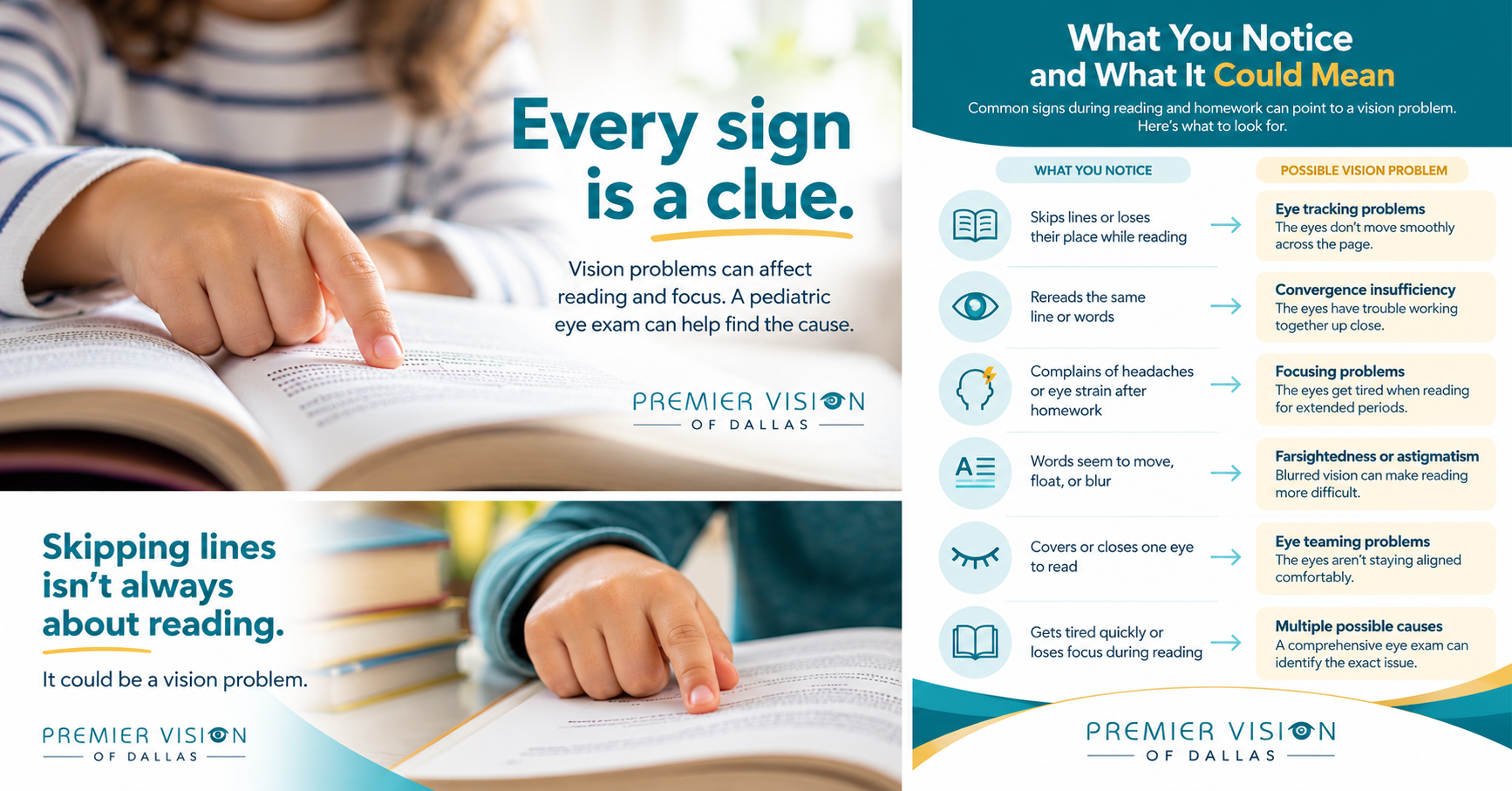
Quick Reference: What You Notice and What It Could Mean
| What You Notice | Possible Vision Problem |
|---|---|
| Words move, float, or double | Convergence insufficiency |
| Headaches after reading or homework | Convergence insufficiency, focusing problem, farsightedness |
| Clear at first, blurry after a few minutes | Focusing problem (accommodative insufficiency) |
| Skips lines or rereads without noticing | Eye tracking problem |
| Uses a finger to keep their place | Eye tracking problem |
| Avoids reading or close work | Farsightedness, convergence insufficiency |
| Squints or tilts head | Astigmatism, uncorrected prescription |
| Covers or closes one eye | Convergence insufficiency, amblyopia |
| No obvious signs | Amblyopia can be silent; only an exam finds it |
One sign can have several causes. This table is a guide for what to mention at the exam, not a diagnosis.
Is It a Vision Problem or an Attention Problem?
A child who can’t sit with a book, drifts off during reading, and rushes through homework can look a lot like a child with an attention problem. Sometimes it’s vision. Sometimes it’s attention. Sometimes it’s both.
Researchers have noticed the overlap. A 2005 study from UC San Diego found convergence insufficiency and ADHD occurring together about three times more often than expected. That doesn’t mean one causes the other, and an eye exam doesn’t diagnose ADHD. What it does is answer one clear question: is vision part of the picture?
If your child is being evaluated for attention or learning concerns, a comprehensive eye exam is a sensible first step. It’s quick, it’s painless, and it either finds something treatable or rules vision out so everyone can focus on the right answer.
TL;DR (Vision and ADHD): Vision problems like convergence insufficiency can look like attention problems. A pediatric eye exam can’t diagnose ADHD, but it can show whether vision is contributing.
What Happens After the Exam
A pediatric eye exam at Premier Vision of Dallas tests every skill in this article: prescription at distance and near, eye teaming, focusing, tracking, and eye health. If you’ve noticed any of the signs above, tell us before the exam starts. It helps me know where to look closely.
When I find a problem, I walk parents through exactly what it is, how it connects to what they’ve seen at home, and what we’d recommend. For many children, the answer is a prescription for reading or full time wear. For others, it’s a treatment plan for the teaming or focusing problem itself.
If your child’s exam points to convergence insufficiency or a tracking problem that needs vision therapy, we’ll explain what therapy involves and refer you to a trusted vision therapy provider. We stay involved in your child’s eye care, with follow up exams to track how their vision is changing.
One mom shared what happened after a concussion affected her daughter’s vision:
“She lost the ability to focus consistently on objects at varying distances and suffered severe headaches from the eye strain. Dr. Allen understood the issue immediately and recommended a series of exercises that resolved both the focus issue and the headaches.”
Kirsten L., parent, Google review
If it’s been more than a year since your child’s last exam, our guide on why pediatric eye exams matter for learning explains why once a year is the right baseline, and what a comprehensive eye exam can detect beyond vision problems.
Frequently Asked Questions
What are the symptoms of convergence insufficiency in children?
Common symptoms include words that seem to move or double, headaches or eye strain after reading, losing focus after a few minutes of reading, and covering one eye to read. School vision screenings usually don’t detect it.
Can vision problems look like ADHD?
Yes. Vision problems such as convergence insufficiency can cause trouble staying focused on reading, which can resemble attention problems. An eye exam can’t diagnose ADHD, but it can show whether vision is contributing.
Can a farsighted child pass a school vision screening?
Yes. Many farsighted children can see clearly at a distance by focusing harder, so they pass distance screenings but struggle with close work like reading.
Does lazy eye in children always have symptoms?
No. Amblyopia often has no obvious signs, especially when one eye sees well. It responds best to treatment when it’s caught early, which is why annual eye exams are recommended.
Schedule Your Child’s Eye Exam in Addison, TX
If any of these signs sound familiar, an eye exam is the fastest way to know whether vision is part of the story. Dr. Karen Allen provides comprehensive pediatric eye exams for children ages five and older at 16479 Dallas Parkway, Suite 120, Addison, TX 75001, serving families across Addison, North Dallas, and the greater DFW area. We work with many major vision and medical insurance plans.
Call (214) 206-3380 or schedule your child’s eye exam online.
The sign you noticed is worth following.


